Introducing MIS: A Mining Research Dashboard in Development

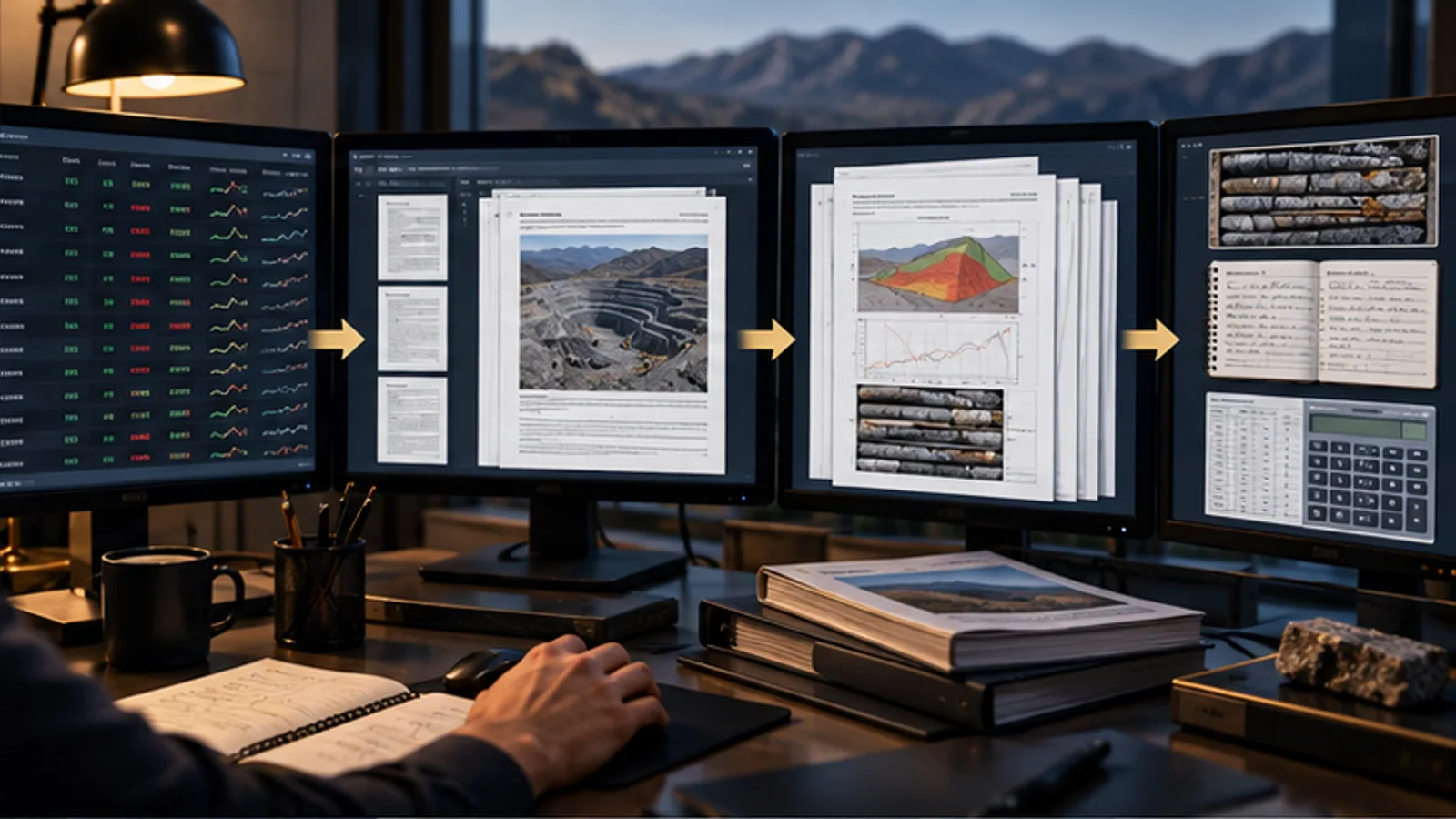
Mining research is scattered across exchange filings, technical reports, financial statements, permit records, and price data. MIS, the Mining Intelligence System, is a proposed members dashboard for organizing that work.
The status matters: MIS is in development. It is not currently presented here as a live, fully integrated, or independently validated market-data service. No performance history, coverage count, refresh guarantee, or release date is claimed.
Product-status and source check: 27 July 2026.
The design goal
MIS is intended to help a researcher answer:
- Which primary document supports this field?
- When was the source published and retrieved?
- Is the value reported, calculated, estimated, or editorial?
- Is the value current enough for the decision?
- What changed since the previous filing?
- Which uncertainty or missing field could reverse the conclusion?
The aim is a source map and review queue, not an oracle or automated instruction to buy or sell.
The provenance standard
Every material field is intended to carry:
- issuer and security identifier;
- source organization and document title;
- direct source link;
- document date, effective date where relevant, and retrieval time;
- unit, currency, period, and ownership basis;
- transformation or formula;
- status such as observed, company guidance, third-party estimate, or scenario;
- verification and staleness flags.
For U.S. issuers, a primary starting point is SEC EDGAR. Canadian and Australian issuers can be checked through SEDAR+ and ASX market announcements. Technical claims should point to the relevant qualified-person report and effective date.
What a calculation should look like
A dashboard may calculate a simple value such as attributable production:
reported project production × economic ownership percentage
That result must be labeled calculated, retain both inputs, state the period, and avoid implying ownership terms are uncomplicated. Streams, royalties, joint ventures, and non-controlling interests can require a different treatment.
Company-reported AISC is another example. MIS should retain the issuer’s definition and reconciliation because AISC is a non-GAAP or non-IFRS measure without a universal definition across companies.
Planned review layers
| Layer | Intended function | Required limitation |
|---|---|---|
| Source record | Preserve the filing or official release behind a fact | Link can break; document can later be amended |
| Normalized field | Put units and periods into a common view | Normalization can hide issuer-specific definitions |
| Calculation | Show formula and inputs | Output inherits source and modeling errors |
| Review trigger | Flag a new filing, stale value, or broken assumption | A trigger is not a recommendation |
| Editorial note | Explain context in plain language | Must be labeled opinion and dated |
What MIS will not promise
MIS is not intended to guarantee complete global coverage, real-time accuracy, profitable signals, or suitability for any person. Public filings can be late, amended, inconsistent, or wrong. Automated extraction can misread tables. A technically accurate field can still be economically misleading without context.
The product must therefore be tested against source documents, with error reporting and visible uncertainty, before any production capability is described as verified.
Join the development waitlist
Readers who want progress updates and an opportunity to comment on the research workflow can use the site’s subscription form to join the waitlist. Joining does not purchase an investment product, create an advisory relationship, or provide access to a live dashboard today.
Feedback is most useful when it identifies the exact filing, field, comparison, or alert that would save research time without hiding its source.
FAQ
Is MIS live now?
No. This article describes the intended design and waitlist status.
Does MIS tell members what to buy?
No. The planned workflow organizes evidence and review triggers. It does not make personalized recommendations.
Are screenshots or examples live data?
Unless explicitly labeled with a source and retrieval time, they should be treated as design concepts or demonstrations.
This article is informational and describes a product concept under development. Features, coverage, and release plans may change.
MISmining intelligencedashboardwaitlistinvesting education