Gold and Silver Miners vs. Metal: Operating Leverage Explained
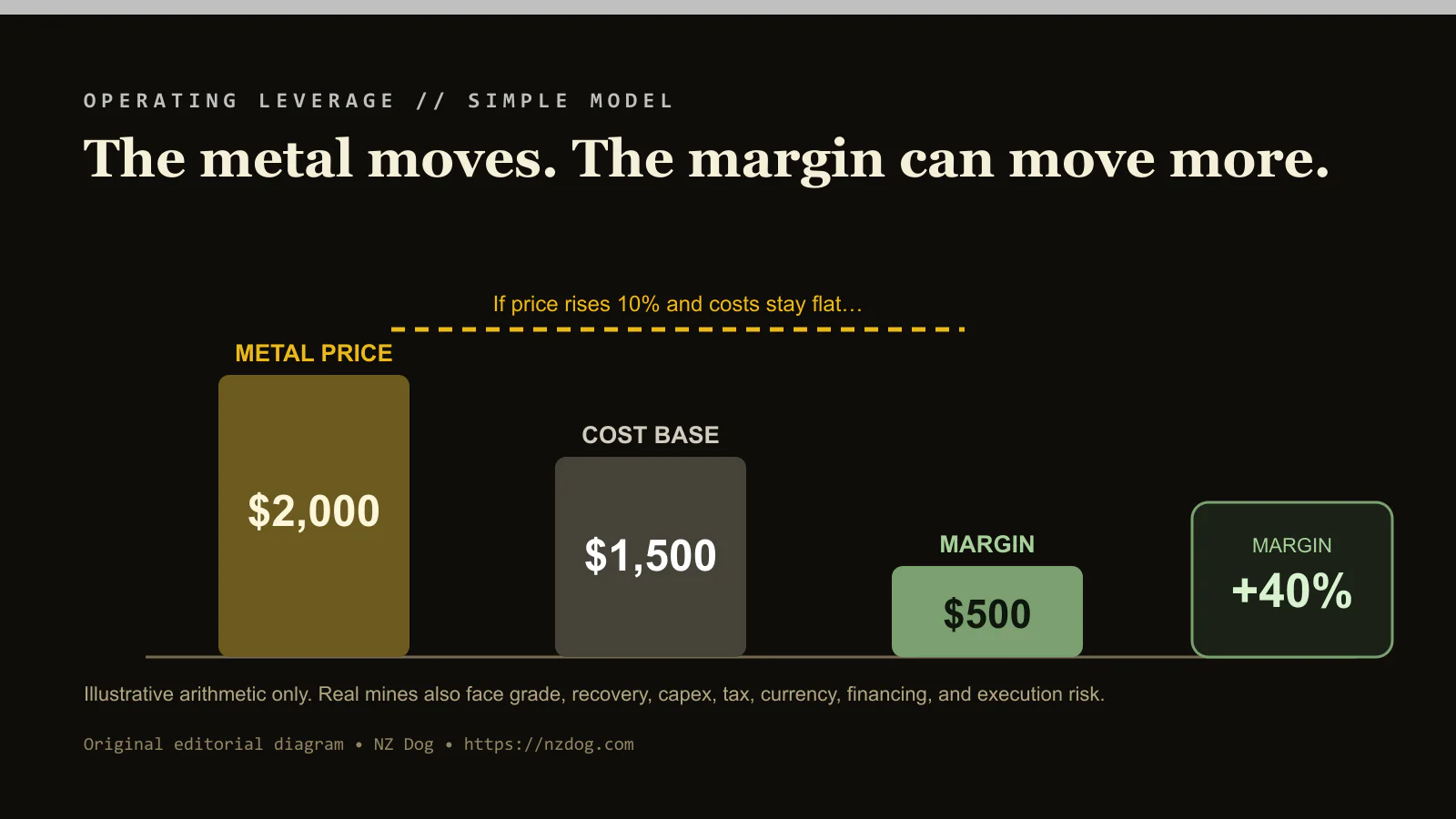
Image: NZ Dog
Owning metal and owning a miner are different legal and economic exposures. A bullion owner holds a physical asset. A metal-linked exchange-traded product holds or references assets under its own terms. A mining shareholder owns part of a company with employees, permits, contracts, liabilities, financing needs, and geological risk.
This guide explains the mechanics. It does not rank the exposures or recommend a security.
Source check: 27 July 2026. Live commodity prices are omitted because they change and because a single quote is not needed to explain leverage.
Operating leverage
A simplified operating margin per payable ounce can be written as:
realized metal price - relevant cash cost
Suppose, only as an arithmetic example, that a producer realizes $2,000 per ounce and the selected cost measure is $1,500. The simplified margin is $500. If the realized price rises 10% to $2,200 while that cost remains unchanged, the margin becomes $700, a 40% increase.
That example illustrates sensitivity, not a company forecast. Actual profit also includes sales timing, royalties, taxes, by-product credits, depreciation, corporate costs, interest, hedges, working capital, and capital expenditure. Costs rarely remain fixed.
AISC is useful but not standardized
All-in sustaining cost, or AISC, is commonly reported by gold and silver producers. It is a non-GAAP or non-IFRS measure. Company filings frequently warn that it has no standardized meaning and may not be comparable with another issuer’s version.
Before comparing AISC:
- read the issuer’s definition and reconciliation;
- check whether the denominator is produced or sold ounces;
- identify by-product credits;
- separate sustaining from growth capital;
- check consolidated figures against mine-level figures;
- compare guidance with reported results.
AISC should supplement audited statements, not replace them.
Why a miner can fall while its metal rises
Commodity prices are only one input. A mine can face lower grade, poor recovery, an outage, inflation, higher royalties, a permit delay, a revised reserve, political intervention, hedging losses, or equity dilution. A developer may have no operating revenue and depend on external financing. An explorer may never define an economic resource.
The reverse is also possible: a company can improve operations or discover more economic material while the metal is flat.
Gold miners and silver miners are not pure labels
Many deposits contain multiple payable metals. A company marketed as a silver miner may receive substantial revenue from gold, lead, zinc, or copper. A gold producer may use copper revenue as a by-product credit.
Use the latest audited filing to calculate revenue and production exposure by commodity. Do not infer purity of exposure from the company name or website headline.
Compare four exposures explicitly
| Exposure | Principal evidence | Main extra risks |
|---|---|---|
| Physical bullion | Invoice, weight, fineness, custody | Premium, resale spread, authentication, storage |
| Metal-linked product | Prospectus and holdings or index method | Fees, tracking, issuer or custody structure |
| Producer | Audited filings and mine technical reports | Operations, costs, reserves, jurisdiction |
| Developer or explorer | Technical reports, permits, studies, financing | No current production, dilution, project failure |
For U.S. reporting companies, SEC EDGAR provides filings. The SEC’s mining disclosure guide explains the qualified-person and technical-report requirements under Subpart 1300 of Regulation S-K.
A defensible leverage test
Build three scenarios for commodity price, recovery, unit cost, production, and capital expenditure. Reconcile the result to reported cash flow, then test dilution and debt. Label every assumption. If the conclusion depends on costs remaining fixed or every project arriving on time, the model is fragile.
Primary and authoritative sources
- SEC: EDGAR company filings
- SEC: mining property disclosure guide
- LBMA: precious-metals benchmark information
gold minerssilver minersoperating leveragevolatilityinvesting education