AISC Is the Mining Metric Investors Misuse Most

Image: NZ Dog
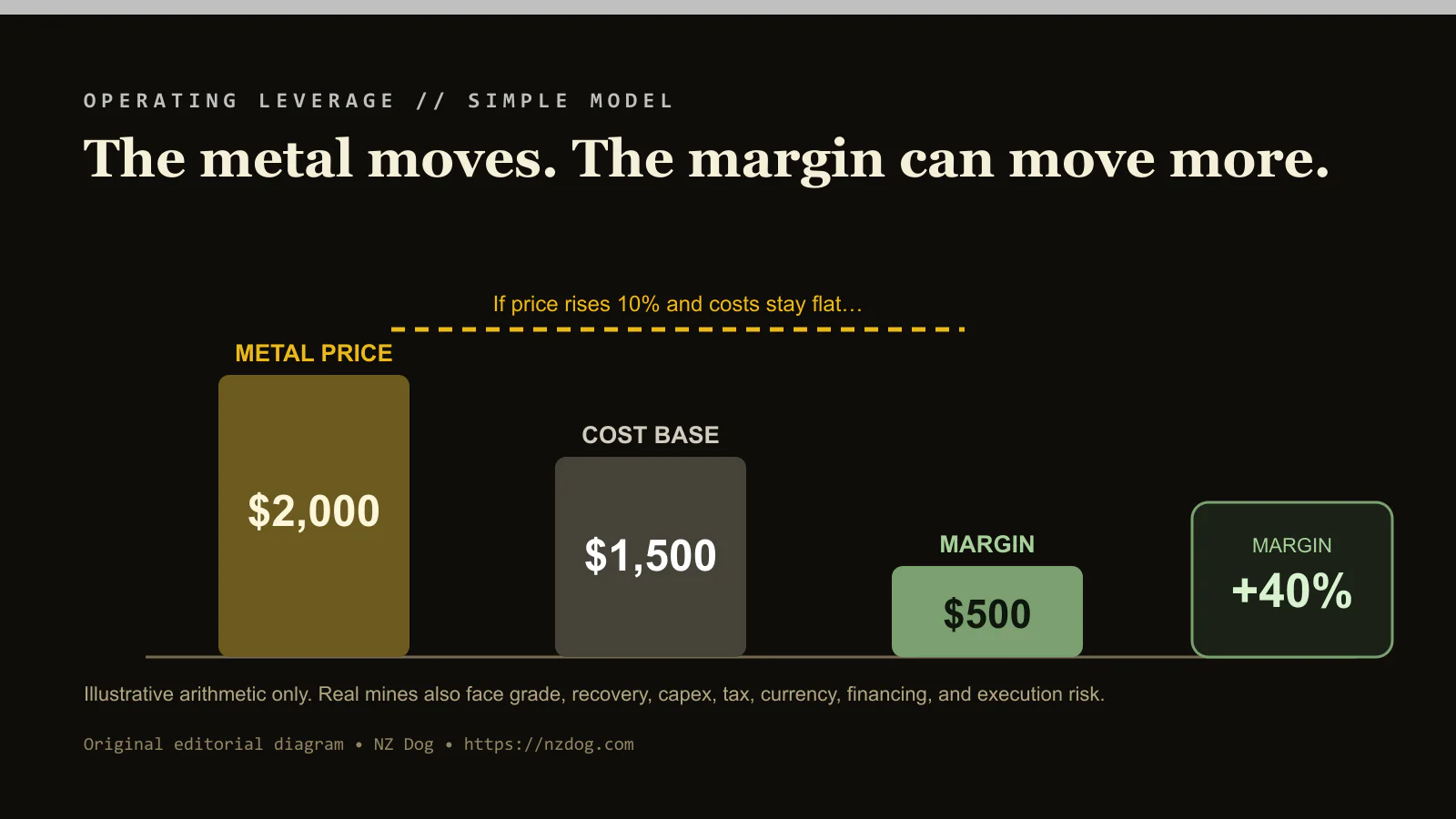
The seductive mining calculation is price minus AISC equals profit. If gold is $X and a producer reports all-in sustaining cost of $Y, the margin must be $X minus $Y.
That shortcut is useful for ten seconds and dangerous for the next ten minutes.
What AISC was built to do
The World Gold Council introduced guidance for all-in sustaining cost to improve on narrower cash-cost reporting. The framework adds items such as corporate administration, sustaining exploration, sustaining mine development, and sustaining capital to adjusted operating costs.
That makes AISC a better view of the recurring cost of keeping current production in business. It still does not include everything an equity investor cares about. The guidance excludes items including income tax, financing charges, business combinations, and some costs classified as non-sustaining.
The judgment hiding inside “sustaining”
The line between sustaining and growth capital is not mechanical. Management must classify projects. A major expansion may sit outside AISC even though shareholders must fund it. Different accounting frameworks and operating structures can also reduce comparability.
The World Gold Council itself notes that reporting practice varies significantly across companies and encourages reconciliation. That means the metric is a starting point for comparison, not a universal accounting truth.
Five ways the shortcut breaks
- By-product credits: Revenue from copper, silver, or other products may reduce reported cost per gold ounce.
- Production mix: A high-grade quarter can temporarily improve unit cost.
- Deferred work: Lower sustaining spend today may create a maintenance bill later.
- Corporate and financing burden: Debt interest, tax, and certain head-office costs affect shareholder cash.
- Growth classification: Expansion capital can be real cash outflow while excluded from sustaining cost.
A better margin bridge
Start with realized metal revenue, not a spot-price screenshot. Subtract reported operating costs and reconcile to AISC. Then continue through taxes, interest, working capital, non-sustaining capital, acquisitions or disposals, and changes in cash and debt.
Compare at least four quarters. If AISC falls, ask whether grade, stripping, currency, energy, royalties, or by-product credits caused it. If production rises, check whether sustaining work was postponed.
Finally, read the footnote defining the company’s measure. Non-GAAP labels can look identical while the underlying reconciliations differ.
Current context
World Gold Council data available in 2026 reported industry AISC as of late 2025 and described rising sustaining capital, input costs, and royalties as contributors. That industry series is useful context, but a global average does not price one mine’s geology, jurisdiction, currency, or life.
Sources and limits
- World Gold Council: Guidance note on AISC and all-in costs
- World Gold Council: Production-cost data and methodology
- World Gold Council: Full-year 2025 gold supply review
The World Gold Council is an industry body, and AISC remains a non-GAAP measure. This article is educational and is not investment advice.
Key takeaway
AISC is valuable precisely because it is broader than cash cost. It is still not net profit, free cash flow, or total life-of-mine cost. Follow the reconciliation all the way to the balance sheet.
AISCgold minersmining costsnon-GAAP